China Thinks America Is Manipulating the Gold Market. Here’s How Beijing Plans to Prove It.
...
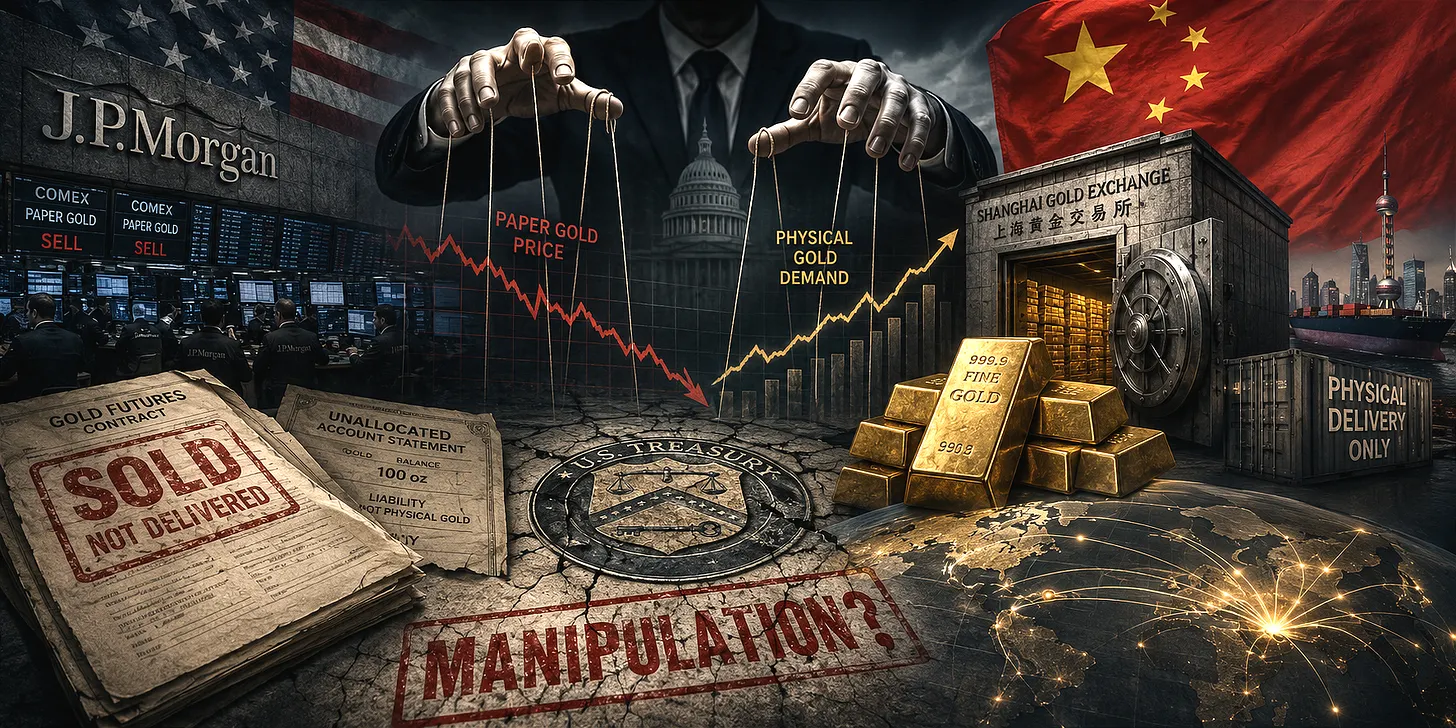
The deeper danger is not simply that China owns more gold. It is that Beijing may be using its physical accumulation to test whether the Western paper-gold architecture has become part of the mechanism through which the United States can make the monetary alternative to its own debt appear cheaper than the underlying physical market would otherwise allow. That remains a hypothesis, not an established fact, but China is building exactly the kind of system capable of testing it without making the accusation formally. More physical settlement, more Asian custody, deeper local clearing and a growing pool of sovereign bullion create the conditions under which any weakness in the relationship between financial gold and deliverable gold becomes progressively harder to disguise.
A futures position can be created almost instantaneously, while new physical supply requires mines, capital, energy, labor, refining capacity and years of development. The stock of gold above ground is enormous, but the amount available for immediate sale at any particular price is not. If Western financial markets repeatedly establish a price low enough to persuade China to buy but not high enough to persuade sufficient existing holders to sell, the adjustment cannot be postponed indefinitely. Either the price rises until physical supply emerges, or the symptoms of scarcity begin appearing elsewhere in the market.
That is where the stakes become much larger than bullion. If Beijing succeeds in making physical settlement more important to global price discovery, China will have weakened one of the quiet structural advantages of the Western financial system: the ability to establish the international price of a scarce physical asset through markets dominated by financial claims. It would gain greater monetary optionality at precisely the moment Washington is becoming more dependent on foreigners continuing to accept an expanding supply of American liabilities.
Should China be wrong, the damage is limited. More bullion migrates toward Asia, Shanghai becomes a more important market and Beijing ends up holding considerably more gold.
Should China be right, America has a much larger problem. Beijing will have spent years converting financial claims into physical assets while Washington expanded debt, leverage and synthetic exposure throughout a system whose credibility still depended on the assumption that paper and physical remained economically interchangeable. The weakness would probably emerge gradually, through higher premiums, migrating inventories, more expensive physical settlement and a widening difference between the price quoted by financial instruments and the price required to obtain the asset those instruments supposedly represent.
...